Choosing the right irrigation system for hay ground around Madras can make or break your season. The system you buy affects yield, hay quality, labor, energy costs, and long‑term value. If you are comparing center pivots, wheel lines, or flood irrigation on a Jefferson County property, a clear framework helps you see past the equipment list and focus on performance and cost. This guide walks you through the tradeoffs so you can match a system to your fields, water, and power. Let’s dive in.
Madras irrigation basics
Central Oregon around Madras is semi‑arid with low annual precipitation and a short growing season. Irrigation is essential for hay and alfalfa. Your water supply, power source, soils, and field shape will shape the best choice for you.
- Water sources. Irrigation water typically comes from surface water delivered through irrigation districts or groundwater pumped from local aquifers. Water rights priority and seasonal allocation rules determine when and how much water you can use.
- Power access. Reliable electricity or fuel for pumps is as important as the sprinkler type itself. Energy costs per acre‑inch can outweigh initial equipment price.
- Soils and slope. Flat, uniform fields favor surface or flood irrigation. Mixed soils and variable topography tend to perform better with pressurized sprinklers that can apply water more slowly and uniformly.
- Crop priorities. For hay and alfalfa, consistent coverage and control of timing help protect yield and leaf retention. Sprinklers usually make this easier than flood systems.
Center pivots: strengths and tradeoffs
How pivots work
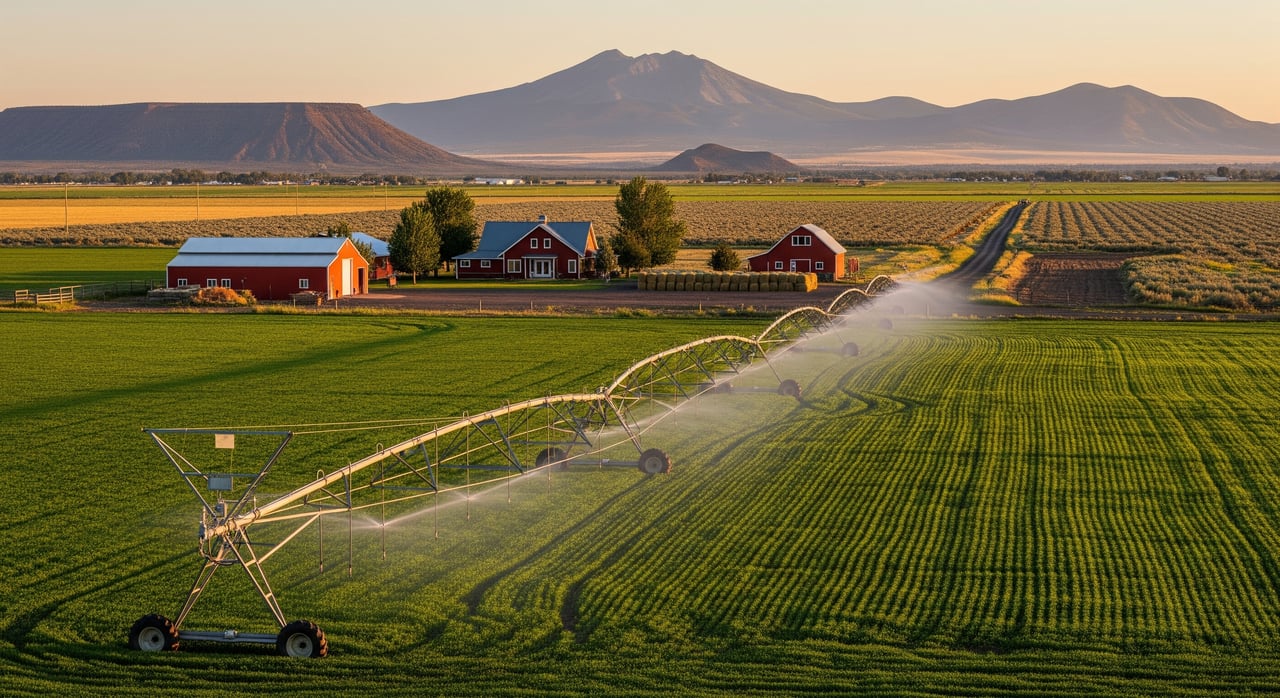
Center pivots are motorized spans that rotate around a central point, applying water through nozzles. They are common on large circular or square fields.
Pros for hay ground
- High uniformity and precise control of timing and depth, which supports yield and hay quality.
- Lower daily labor than flood irrigation due to automated travel and controls.
- Operates at lower application rates per hour to reduce runoff, helpful on variable soils.
- Compatible with fertigation and chemigation.
- Can be set up with low‑pressure nozzles to improve water use efficiency.
Considerations and costs
- Higher capital cost per pivot, and corners on rectangular fields may be left unirrigated without additional systems.
- Requires reliable power and a pump sized to deliver the needed flow and pressure.
- Ongoing maintenance on drives, gearboxes, tires, panels, and sprinklers. Major components are significant capital items over the life of the system.
When pivots fit
Choose a pivot when you have relatively uniform fields, dependable power and water, and a need to maximize hay quality with precise scheduling. Pivots often win in water‑limited years because you can fine‑tune timing and depth.
Wheel lines and laterals
What they are
Wheel lines, hand‑move systems, and lateral moves use wheeled pipes or motorized lines that you shift across rectangular or irregular fields.
Pros to consider
- Lower initial capital than a pivot for certain layouts.
- Flexible for strips and irregular shapes where a pivot would miss corners or be impractical.
- Can operate with smaller pumps in some configurations.
Limitations
- More labor to move and set lines, even with motorized lateral moves.
- Uniformity and efficiency depend on correct spacing, levelness, and management.
- Maintenance on tires, couplings, and engines is hands‑on.
Best fit
Wheel lines make sense when you need flexibility, have narrow fields or odd shapes, or want a moderate upfront cost. With good management, they can deliver efficiency between pivots and flood systems.
Flood irrigation at a glance
How it works
Flood or surface irrigation delivers water by gravity across furrows, basins, or levees from head ditches or turnouts.
Advantages
- Low upfront equipment cost, especially where gravity delivery is available.
- Simple to operate with basic infrastructure. Many legacy irrigated acres still use flood.
Challenges
- Lower uniformity and typically lower water use efficiency than sprinklers. Losses to runoff and deep percolation can be higher without careful management.
- Higher labor for gating, ditch maintenance, leveling, berm repair, and sediment control.
- Harder to control timing and frequency, which can affect hay quality around cutting.
- Risk of salinity or waterlogging with poor management.
Where flood can fit
Flood can work where water is plentiful, fields are gently sloped and well leveled, and labor is available. It is less forgiving in dry years or when allocations are reduced.
Power, water duty, and O&M
Pumping and power checks
Your energy cost per acre‑inch often drives the economics. Larger pivots may require higher horsepower pumps and three‑phase power, while smaller wheel‑line systems may run on smaller pumps or engines. Before you buy, collect:
- Pump curve, nameplate, and recent service records.
- Power type and capacity, plus electric bills or fuel records.
- Any demand or seasonal electric rates that change operating cost.
Water duty and scheduling
Water duty includes both how much water the crop needs and your system’s capacity to deliver it on time.
- Sprinklers let you apply lower per‑hour rates, reduce runoff, and match crop evapotranspiration with more frequent, lighter sets.
- Flood systems often require larger volumes per set and longer application windows to push water across the field.
- To verify capacity, ask for pump run hours, flow rates, and past application depths to estimate acre‑inches applied each season.
Maintenance needs by system
- Center pivots. Routine lubrication, nozzle and seal replacement, drives and electrical checks, tires, and tower care. Major items include gearboxes, spans, and motors.
- Wheel lines. Pipe and wheel maintenance, nozzle upkeep, and engine or gearbox service if motorized. Expect more frequent hands‑on work.
- Flood. Ditch and turnout upkeep, levee repair, sediment management, and field grading. Labor is seasonal and intensive.
Lifespan and records
Well‑maintained pivots and lateral systems can run for decades with part replacements. Surface systems can last if you keep up with earthwork. Maintenance logs, parts on hand, and service history help you gauge risk and budget for replacements.
Economics and value
Capital vs operating cost
Pivots usually cost more up front than flood or basic wheel‑line systems, especially if you need new power service or pump upgrades. Over time, sprinklers can lower labor and water use per ton of hay, which helps offset capital. Your break‑even depends on local power rates, labor costs, water availability, and hay prices.
Productivity and quality
Sprinklers typically produce more crop per unit of water because they distribute water uniformly and allow you to irrigate on schedule. For alfalfa, the ability to time irrigations around cutting can protect leaf retention and quality. Flood can yield well with skilled management and ample water, but is less flexible when allocations tighten.
Labor and management
Flood requires more daily attention and seasonal earthwork. Pivots reduce manual chores but need technical know‑how for electrical and mechanical service. If you plan to convert from flood to sprinklers, account for piping, pump sizing, field layout changes, and power upgrades.
Resale and marketability
In markets where water is scarce or energy costs are meaningful, efficient sprinkler systems can increase marketability and support value. Buyers focus on the full package: water right seniority, assessed acre‑feet, pump capacity, reliable power, equipment age, and any local rules that affect diversions and reporting.
Incentives for upgrades
Federal and regional programs often help fund irrigation efficiency projects.
- USDA NRCS EQIP. Common support includes converting flood to sprinklers, installing pipelines, upgrading sprinkler packages, and irrigation water management practices. Funding levels and eligible practices change each year and are locally prioritized.
- RCPP and state options. Some programs add funding or technical assistance for larger or watershed projects. Some districts may offer loans or rebates for piping and water‑saving work.
How it works:
- Competitive applications are ranked on conservation benefits and water savings.
- Cost‑share typically covers a portion of eligible costs. Exact shares vary by program and sign‑up.
- Approved projects require plans, engineering, and long‑term operation and maintenance commitments.
If you are exploring an upgrade, contact the local NRCS office in Jefferson County early to confirm current incentives and timelines. If a seller completed a cost‑share project, ask for the contract details because obligations can transfer with the land.
Buyer due diligence checklist
Use this checklist when you evaluate irrigated hay ground around Madras:
Water and rights
- Obtain the water right certificate or district account. Verify priority date, rate, and authorized acreage or acre‑feet.
- Review seasonal delivery history and any metering or reporting requirements.
- Ask about recent curtailments or local rules that affect diversions and timing.
Pumping and power
- Get pump nameplate, pump curve, suction and discharge details, and recent service records.
- Confirm single or three‑phase power, service capacity, and recent bills. Check for demand or seasonal rates.
- Verify ownership and transfer of generators, transformers, and control panels.
System inventory and condition
- Pivots. Span length, age, model, gearbox and motor condition, sprinklers, corner systems if any.
- Wheel lines. Number of lines, engine horsepower if self‑propelled, pipe and wheel condition.
- Flood. Ditch and headgate condition, field leveling, signs of erosion or sedimentation.
- Ask for maintenance logs, spare parts lists, and inspection reports.
Field characteristics
- Field slope and grade, existing berms or terraces.
- Soil types and variability. Obtain a soil survey if possible.
- Field size and shape to assess pivot coverage or wheel‑line logistics.
Operational records
- Pump run hours, fuel or electric use, number of irrigations, and typical application depths.
- Hay yields and any notes on quality across seasons.
Legal and program items
- Any NRCS or other conservation contracts. Review terms and obligations.
- Basin rules or adjudications that affect rights in the area.
- Easements or access issues for moving and servicing equipment.
Conversion feasibility
- For flood to sprinkler conversions, price out power upgrades, piping, and pump capacity.
- Note site constraints like rocky ground, access, and distance to power.
Putting it together for Madras hay
When you weigh pivots, wheel lines, and flood systems around Madras, start with your water reliability and power costs, not the brand of sprinkler. On fields with steady power and uniform layout, a pivot often produces the most hay per unit of water and cuts daily labor. Where fields are narrow or irregular, well‑managed wheel lines can strike a balance of cost and flexibility. Flood can still work on flat, well‑leveled ground with abundant water and available labor, but it is harder to fine‑tune during short irrigation windows.
If you want practical help matching a system to your fields and water rights, or you are weighing an upgrade before listing, reach out. Our team brings hands‑on ranch management experience and transaction guidance across Central Oregon. To talk through a specific property or request a property valuation, connect with Jerry W Hicks.
FAQs
Which irrigation system is most water efficient in Madras?
- Well‑designed sprinklers, like center pivots or properly managed wheel lines, typically produce more crop per unit of water than flood systems because of better uniformity and scheduling control.
Is a center pivot right for small or irregular fields near Madras?
- Not always. Pivots excel on uniform fields with reliable power and water, while wheel lines can better serve narrow strips and irregular shapes at a lower initial cost.
How do power costs affect irrigation choice in Jefferson County?
- Energy cost per acre‑inch is a major recurring expense. Systems that apply water efficiently can lower total pumping, which may justify higher upfront cost if power rates or lift are significant.
What should you review in water rights when buying irrigated ground?
- Verify priority date, authorized diversion rate and volume, delivery history, and any metering, reporting, or curtailment rules that could limit timing or amount applied.
Can NRCS help pay to convert flood to sprinklers in Central Oregon?
- Yes. Programs like EQIP often cost‑share efficiency upgrades such as sprinkler installation and pipeline replacement, with funding levels and eligibility set locally and updated annually.
How does irrigation timing impact alfalfa hay quality around Madras?
- Sprinklers allow lighter, more frequent sets and better timing around cutting, which helps reduce plant stress and protect leaf retention, supporting consistent quality.